
Abstract
The study presents a novel workflow integrating artificial intelligence (AI) into the structured reporting of radiology images, specifically chest X-rays. This integration aims to streamline the reporting process, enhance report accuracy, and reduce the time required for radiologists to generate reports. The research highlights the pipeline's efficiency in automatically populating structured reports with AI-generated findings, significantly reducing the time taken to complete reports and improving the consistency and quality of radiological interpretations.
Methods
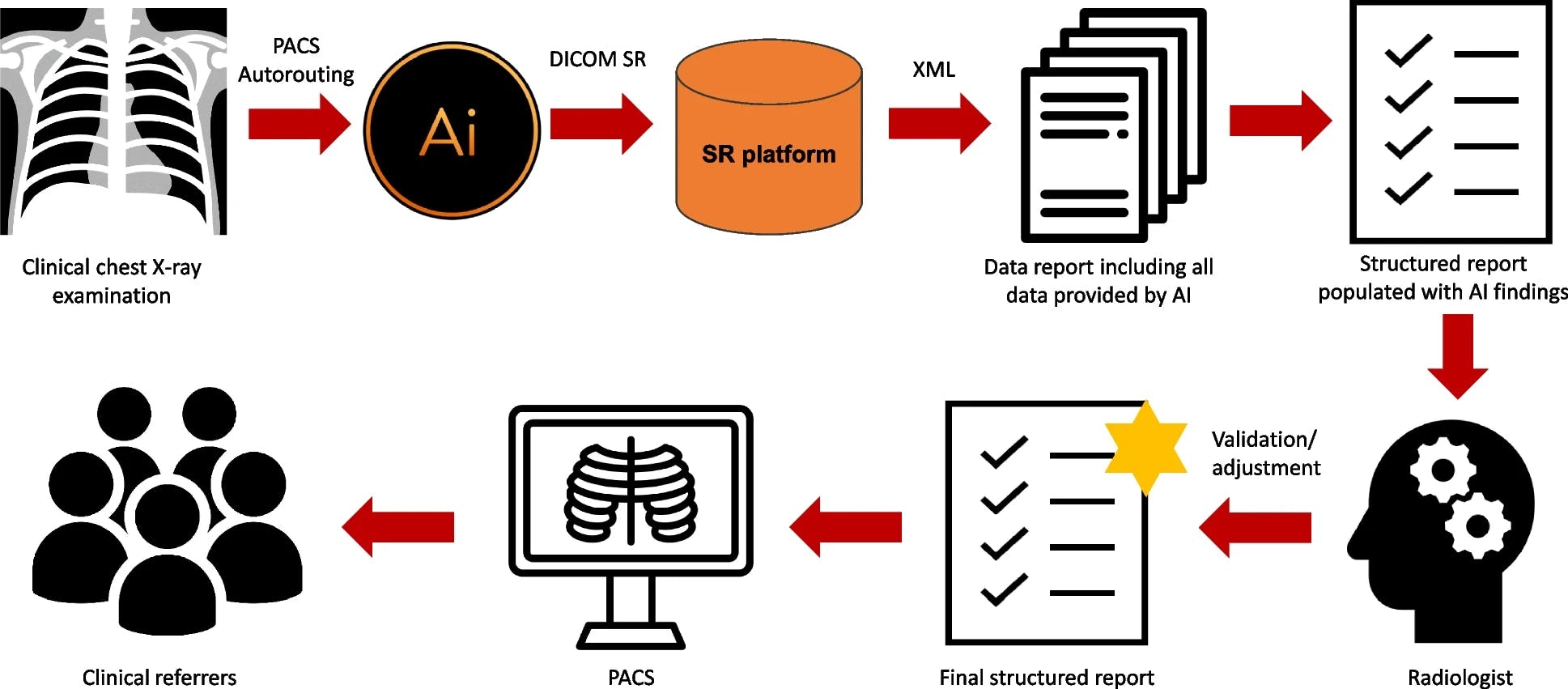
The workflow involves the automatic transfer of chest X-ray images from the Picture Archiving and Communication System (PACS) to an AI analysis tool. The AI processes these images and outputs the results in DICOM Structured Report (SR) format. These results are then converted into an XML format and extracted into a data template, which pre-populates the structured report with clinical findings, including their probabilities and exact locations. Radiologists can modify, confirm, or reject the AI findings before finalizing the report. The study involved a comparative evaluation where radiologists created reports using free-text, conventional structured reports, and AI-integrated structured reports.
Results
The study evaluated 60 chest X-ray examinations, where the AI detected a total of 294 pathologies. The results demonstrated that the reporting time using the AI to Structured Report (AI SR) pipeline was significantly shorter, averaging 66.8 seconds compared to 85.8 seconds for free-text and 85.6 seconds for conventional structured reports. Additionally, the completeness and correctness of the reports were rated higher for the AI SR pipeline, with substantial inter-rater agreement (α=0.73), indicating high consistency among radiologists.
Conclusions
The implementation of the AI-integrated structured reporting workflow has shown to be effective in reducing reporting time and enhancing the quality and consistency of radiological reports. The study concludes that such a workflow can significantly improve radiological practices by providing a standardized, efficient, and reliable method for integrating AI findings into structured reports, ultimately benefiting clinical decision-making and patient care.
Excited to explore further? Send us an email at [email protected].