

Best AI Radiology Solutions in 2025: The Next Era of Imaging
AI-driven imaging tools have significantly contributed to enhancing the precision, cost-effectiveness, and safety of patient care. In addition to facilitating timely and accurate diagnoses, these tools streamline quality control and workflow efficiency. Through automated risk stratification, AI-powered imaging becomes a potent ally in identifying high-risk patients, allowing for specialized and optimized medical attention.
With continuous technological advancements and the harnessing of big data, the future of diagnostic imaging appears bright, guided by the unparalleled expertise of AI-powered radiologists. Here is a list of the top AI-powered radiology startups worth exploring in 2025, signifying the growing interest and potential in this field.
Rayscape
Rayscape is a complete digital assistant designed to empower doctors with powerful Artificial Intelligence tools, enabling better decision-making and improved patient care. Focused on the health of the lungs, this comprehensive suite of products seamlessly integrates into medical workflows, allowing radiologists to analyze chest X-rays and lung CTs faster and more efficiently.
Rayscape CXR, an integral component of the software, revolutionizes patient triage by automatically distinguishing between normal X-rays and those with anomalies. With the ability to detect over 148 pathologies, it empowers doctors with the following:
- Additional X-ray visualizations for unparalleled accuracy
- Localization of the lesions on the scan
- Calculation of the cardio-thoracic index
- Patient prioritization based on identified pathologies
For lung CT analysis, Rayscape's Lung CT offers precise detection, measurement, and tracking of nodule evolution. This enables effective lung cancer detection and management, especially by identifying high-risk patients and notifying doctors of potentially malignant nodules during regular check-ups. From preventive monitoring to early detection and emergency care, the software streamlines the entire process, generating growth reports and adhering to international guidelines such as Fleischner, BTS, or Lung Rads.
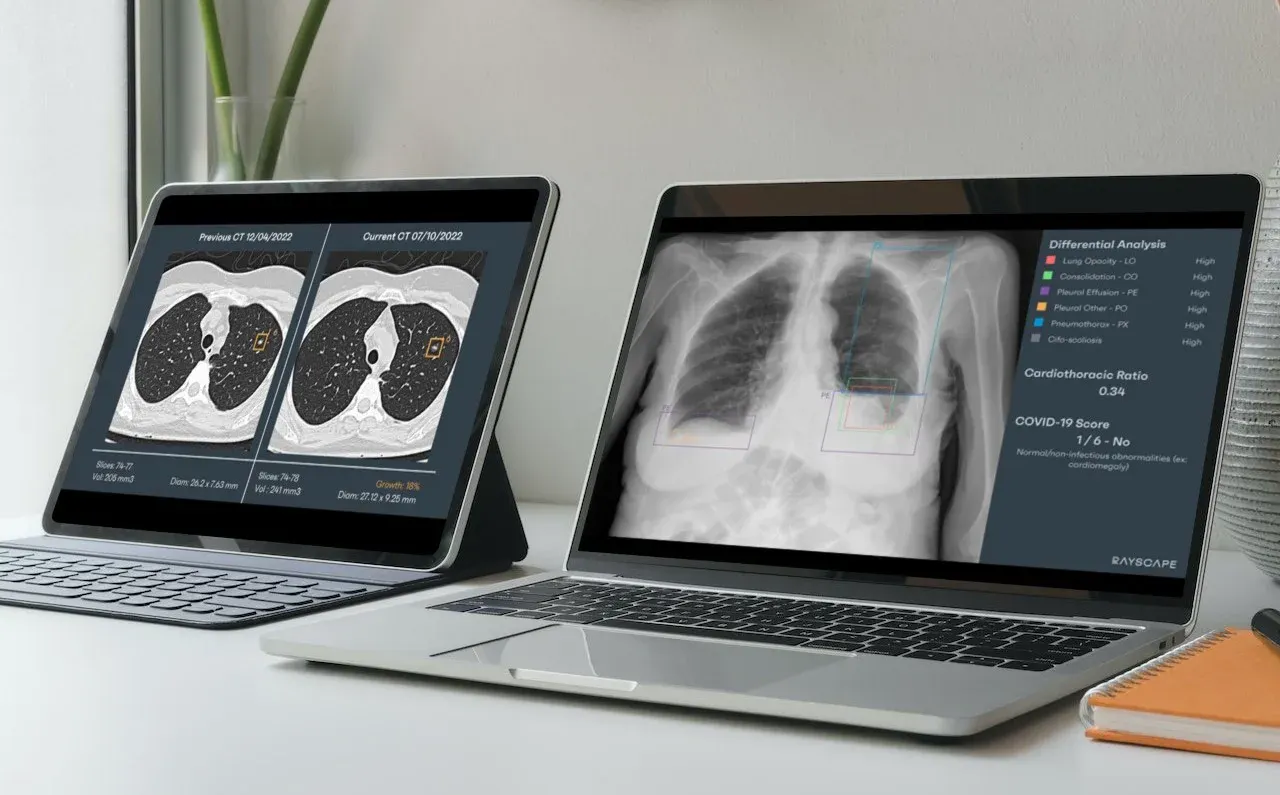
Rayscape can be installed into the pre-existing infrastructure and flows without disruptions, with fully customizable options for both On-Premise or Cloud integrations.
AZmed
Rayvolve, a computer-aided diagnosis (CAD) tool developed by AZmed, is changing the way radiologists and emergency physicians detect fractures on standard X-rays. Powered by artificial intelligence, Rayvolve analyzes X-rays, rapidly identifying potential fractures in trauma patients. The software possesses the capability to detect various types of fractures, including clavicle, humerus, radius, ulna, femoral, tibia, fibula, and pelvis fractures. To further optimize performance, the solution incorporates several features for examination prioritization and activity monitoring. Its comprehensive development aims to elevate radiologists' skills, ensuring enhanced accuracy and time optimization in their diagnostic processes.

Annalise.ai
Annalise Enterprise CXR is an AI clinical decision-support solution designed for interpreting chest X-rays, providing invaluable assistance to clinicians in both urgent and non-urgent care settings. Leveraging its advanced capabilities, the solution can detect an extensive range of up to 124 findings, including air space opacity, interstitial thickening, volume loss, effusions, lung masses, pneumothorax, pneumoperitoneum, and bone trauma. Acting as a reliable second pair of eyes, Annalise Enterprise CXR promptly notifies clinicians of suspected, enabling swift and informed decision-making.

Noteworthy features of this solution encompass the analysis of up to three images per study, encompassing both frontal and lateral images. The software presents a confidence bar, displaying the likelihood of each finding and the uncertainty of the AI model, further enhancing diagnostic precision.
Gleamer
Boneview, created by Gleamer, introduces three algorithms to better evaluate bone age and measurements. The Bone Age algorithm utilizes the Greulich & Pyle atlas method, automating bone age evaluation with higher precision and efficiency, thus saving valuable time for radiologists. Additionally, Boneview Measurements streamlines daily measurements, providing an easily interpretable display for key areas such as the spine, legs, feet, and pelvis & hips, simplifying the diagnostic process.

Gleamer provides new methods for detection with its advanced Boneview Trauma algorithm. Capable of detecting fractures, effusions, dislocations, and bone lesions in limbs, pelvis, T/L spine, and rib cage, the algorithm empowers radiologists to identify and address complex traumas swiftly and accurately. Boneview's PACS-neutral approach enables effortless integration with diverse radiology systems, facilitating efficient adoption in different medical environments.
The added advantage of remote installation enhances accessibility and flexibility, allowing healthcare providers to experience the benefits of Boneview's solutions with ease.
Kheiron Medical Technologies
Mia by Kheiron serves as a support system for radiologists, aiding them in the critical recall decision-making process during breast cancer screening. This versatile tool is available in multiple configurations, enabling its use as an independent second reader, a concurrent reader, or as part of a double reader triage. In addition to its recall decision support, Mia boasts an AI-enabled breast positioning and image quality assurance tool, Mia IQ. Focused on mammography and specifically targeting breast cancer, Mia's key features encompass independent second read capability, recall suggestions, suspicious region marking, and image indications, making it a comprehensive and indispensable tool for breast cancer screening and diagnosis.

Viz.ai
Viz.ai offers a range of robust solutions dedicated to the analysis of brain scans, primarily focusing on CT scans and targeting specific neurological conditions. For the detection of cerebral aneurysms, Viz.ai provides tools equipped with advanced algorithms, enabling swift and accurate aneurysm detection, along with timely notifications to medical professionals. Its comprehensive CT analysis extends to stroke cases, with key features encompassing essential functionalities such as perfusion mismatch mapping, notification alerts, and precise calculations.
Additionally, the system is detecting suspected intracranial hemorrhages, empowering healthcare providers with a robust set to enhance diagnostic accuracy and streamline the management of critical brain conditions.

Arterys
Cardio AI, developed by Arterys, is a web-accessible image post-processing analysis software designed for the visualization and quantification of cardiovascular MR images. It is specifically tailored to handle MRI data in DICOM format, enabling manual and semi-automatic border detection for comprehensive analysis. Equipped with a host of features, the software allows seamless loading, saving, and generating of screen displays, as well as the aggregation of quantitative data extracted from cardiovascular images. Among its key features are the segmentation of LV, RV, LA, and RA, semi-quantitative perfusion assessment, quantification of scarring, and wall thickness analysis, along with strain assessment.
Cardio AI supports input from 1.5T and 3.0T cardiac MR machines and produces outputs in the form of color mapping, segmentation contours, and quantitative measurements.

It is important to note that most of these groundbreaking solutions can be found within specialized marketplaces dedicated to AI-powered imaging tools. These platforms serve as centralized hubs, offering a wide range of innovative technologies designed to optimize radiology workflows.
CARPL
CARPL offers a comprehensive and dynamic platform that enables you to discover over 110 AI solutions from across the globe. With CARPL, you can test and monitor these cutting-edge applications through deep clinical and statistical analysis using their proprietary AI testing and monitoring platform. Facilitating seamless deployment, CARPL offers a single integration pipeline and a unified user interface, granting access to multiple AI systems effortlessly. An exciting aspect is the opportunity to explore these AI applications using your data, allowing you to run them live and estimate their value in your specific medical environment. With CARPL, harnessing the potential of AI in radiology and healthcare has never been more accessible and empowering.
Deepc
DeepcOS improves the accessibility of Radiology AI solutions, offering effortless access to a diverse range of cutting-edge technologies. Through strategic partnerships with leading AI vendors, they host a plethora of artificial intelligence solutions in a secure and efficient cloud environment. With a single installation, deepcOS grants radiologists streamlined access to over 35 commercial AI solutions from more than 20 trusted partners.
Ensuring utmost quality and regulatory compliance, they diligently curate the portfolio of solutions by only featuring AI products with regulatory approval, including CE mark and/or FDA clearance. Furthermore, they conduct extensive literature reviews, thoroughly investigating AI engine performance metrics such as sensitivity, specificity, AUROC, training, and test dataset sizes.
Blackford
Blackford boasts an impressive portfolio of over 100 contracted AI solutions, spanning 35 partner vendors and catering to 7 radiology sub-specialties. Their platform is purpose-built to integrate with existing systems, streamlining the process of incorporating multiple disparate AI applications and algorithms, ultimately lightening the load on imaging platforms. They offer a straightforward pathway for adding new AI applications from their market-leading portfolio or in-house developed solutions, significantly reducing implementation time, costs, and long-term maintenance. To ensure continued excellence, Blackford Dashboard™ diligently monitors the long-term performance of their AI solutions, providing constant 24/7 oversight for optimal efficiency and reliability.
Incepto
Incepto presents a new implementation for accessing artificial intelligence in your medical imaging practice, with the flexibility of on-demand availability and no long-term commitment required. Operating across 130 sites throughout Europe, their solutions have gained widespread adoption by over 1000 radiologists, who rely on them daily to enhance their diagnostic workflows. With an impressive track record of analyzing over 10 million images to date, Incepto has curated and CE-marked an impressive selection of 22 AI applications designed specifically for radiology. Going a step further, Incepto is actively engaged in co-creation and development, currently working on the creation of three unique AI solutions, promising to revolutionize the landscape of medical imaging with their cutting-edge technology and visionary approach.
MEDICAI
And besides the platforms and AI solutions themselves, we must not forget the critical technology required to integrate them seamlessly into clinical practice. Smart cloud-based PACS and online DICOM viewers play a foundational role in this ecosystem. These tools ensure that AI-generated insights are not siloed—they are accessible, interpretable, and shareable across institutions and teams. With remote access, real-time viewing, and zero-footprint deployment, they enable radiologists to review both raw and AI-processed images efficiently, laying the groundwork for a truly connected, future-ready diagnostic workflow.
Click Here To Read PART 2 of this guide
If you want to learn more about Rayscape's custom AI solutions, feel free to contact us here.


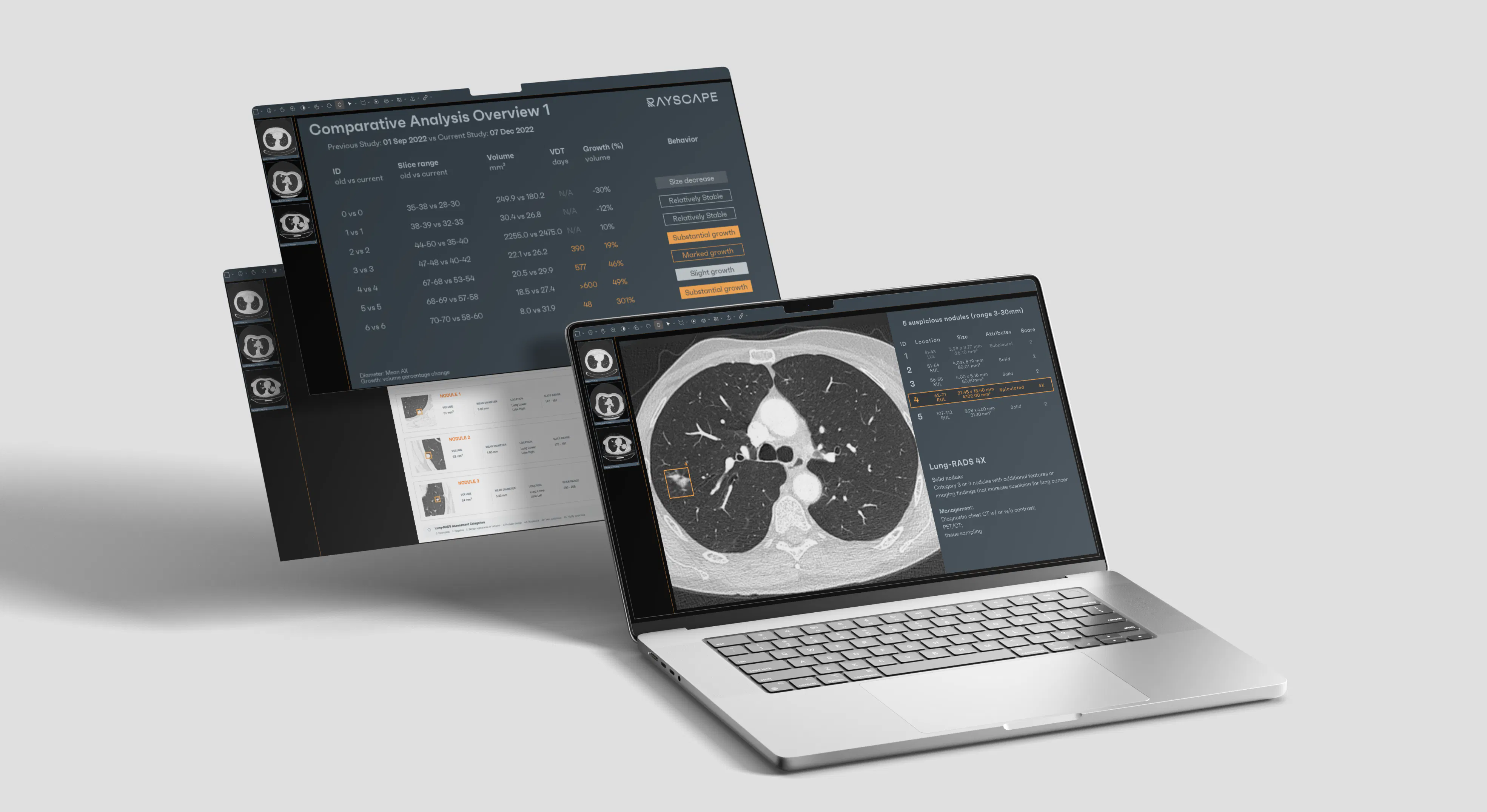

Discover how Rayscape works
integrate Rayscape AI into
your hospital's infrastructure
and improve both your
daily workflow and patients' experience.
