

The ROI of Artificial Intelligence in Radiology: Exploring the Benefits
Introduction:
Imagine if a doctor can get all the information he needs about a patient in 2 minutes and then spend the next 13 minutes of a 15-minute office visit talking with the patient, instead of spending 13 minutes looking for information and 2 minutes talking with the patient.
The healthcare landscape is no stranger to operational challenges. Hospitals and health systems have invested heavily in software and IT systems, but many still find themselves stuck in the manual extraction and deciphering of data that merely highlight problems without offering solutions. It's like investing in a GPS only to find out it can only tell you where you are, not how to get where you want to go.
Enter the superheroes of innovation: artificial intelligence (AI) and machine learning (ML). These cutting-edge technologies are swooping in to save the day for healthcare organizations. They harness the power of data to tackle capacity issues, manage limited resources, and even prevent workforce burnout, all while enhancing the patient experience and improving treatment and diagnostics. Think of them as the Batman and Robin of healthcare operations.
Transforming Healthcare Operations
Let's dive into three exciting examples of how AI and ML are transforming the healthcare landscape:
Tackling staffing shortages: Operating rooms often experience underutilization during certain periods, resulting in costly overtime. It's like having a roller coaster ride for clinicians' schedules, with unexpected twists and turns. AI comes to the rescue by predicting the number and types of cases that will be completed and when. This allows administrators to optimize clinicians' schedules, reducing burnout and creating a smoother workflow. It's like having a well-choreographed dance routine instead of a chaotic mosh pit.
Improving patient scheduling: Remember those long waiting times for appointments? They're about to become a thing of the past. AI-based tools use constraint-based optimization to analyze countless possibilities and provide medical offices with templates that maximize the number of patients seen in a day.
Enhancing discharge management: Predicting when patients will be discharged is like trying to predict the weather—sometimes it's a hit or miss. But with AI, we can now bucket patients based on medical similarities and make better recommendations for their discharge dates. This not only improves bed management but also optimizes throughput across hospitals. Using Artificial Intelligence feels like using a crystal ball that reveals the best path for each patient's journey.
These technologies are not fleeting trends or luxurious indulgences. They are the backbone of operational efficiency in healthcare. They are shaping the fundamentals of our businesses—access, cost structure, and patient experience. They are the secret sauce that elevates any organization to new heights.
Healthcare leaders looking to adopt these tools should carve out a dedicated budget for them. Just as the internet revolution required separate budgets for digital transformation, ML/AI adoption demands the same approach. By empowering business owners to invest in these technologies, organizations can strike a balance between digitization and human resources, propelling growth and operational excellence.

Calculating the ROI of AI in Healthcare
Hospitals and medical practices are currently navigating a challenging environment that is taking a toll on physicians. Recent findings from the European Journal of Radiology shed light on the rapid growth of workload in this field, indicating a doubling in just eight years. Unsurprisingly, this mounting pressure contributes to physician burnout, a concerning issue plaguing the healthcare industry.
Compounding the problem, the practicing population of radiologists is aging, with a significant majority (82%) over the age of 45 and more than half (53%) over the age of 55. As these experienced professionals approach retirement, the demand for radiologists continues to outpace the supply, as emphasized in a 2019 Frost & Sullivan report. The integration of AI tools into radiology workflows presents an opportunity to optimize efficiency and alleviate the burden on physicians.
One particularly intriguing prospect is the potential of AI to reduce healthcare spending. A recent research paper estimates that widespread adoption of AI could lead to savings of 5% to 10% in healthcare spending, equivalent to a staggering $200 billion to $360 billion annually in the US. While these figures are significant, showcasing a promising return on investment (ROI), the challenge lies in effectively demonstrating this ROI.
As healthcare resources become increasingly scarce, the optimal utilization of these resources to maximize both patient outcomes and financial performance becomes paramount for the future success of healthcare institutions. To efficiently and effectively leverage AI in the healthcare setting, organizations must thoroughly understand how to deploy these technologies and anticipate the expected ROI.
Challenges in ROI Evaluation
Traditionally, AI deployment has been approached by treating each AI algorithm as a standalone tool, aiming to enhance the quality of patient care, streamline workflows, and automate labor-intensive tasks. However, is this the most effective way to implement healthcare AI? Does the individual algorithm approach truly deliver the best ROI for hospitals?
Calculating the ROI when using AI in healthcare poses several challenges. Evaluating the ROI requires a comprehensive consideration of the resources invested in identifying, evaluating, and deploying AI. Unfortunately, many AI vendors offering single-point solutions fail to accurately represent the true costs involved, often providing an ROI calculation based solely on the cost of deploying the algorithm itself, neglecting the broader investment made by the deploying organization.

To illustrate this situation, let's examine an example of an ROI provided by a vendor. Suppose the AI deployment cost is quoted at $500,000, with the algorithm projected to generate $600,000 in total revenue, resulting in a seemingly attractive 20% ROI. However, this ROI calculation fails to account for the full costs incurred by the organization in terms of resource investments in identifying, evaluating, and deploying the AI.
A comprehensive AI ROI calculation should encompass various factors. It should not only include the cost per scan or the total cost of deploying the AI but also consider the internal organizational costs, such as the value of administrative personnel's time invested in the identification, evaluation, and deployment process. Additionally, the time and productivity impact on clinicians, workflow interruptions, changes to processes and workflows, and the involvement of IT personnel and clinical support staff should all be considered when assessing the overall deployment process.
These costs can range from administration expenses of $8,000 to $10,000, clinician time costs of $100,000 to $125,000, IT personnel costs of $75,000 to $100,000, and clinical support staff costs ranging from $25,000 to $50,000. By accounting for these comprehensive costs, organizations can gain a more accurate understanding of the true ROI of their AI investments.
The Potential of Artificial Intelligence in Radiology
As AI continues to reshape the healthcare landscape, organizations need to perform meticulous ROI calculations that consider all relevant factors. Only by doing so can healthcare institutions fully harness the power of AI, optimize operational efficiency, and pave the way for a transformative future in patient care. The era of AI-driven healthcare is upon us, and understanding the ROI is a critical step toward unleashing its full potential.
As AI continues to advance, the radiology field is increasingly adopting and relying on AI tools. This brings up an important question: How should practices pay for these tools? During the development phase, vendors typically collaborate with radiologists and offer their tools through subscription-based models. Fortunately, in recent years, the Centers for Medicare and Medicaid (CMS) have recognized the value of these AI tools and introduced several reimbursement opportunities.
Let's take a look at some noteworthy examples. In September 2020, Viz.AI's Large Vessel Occlusion AI algorithm made waves as the first radiology algorithm to be reimbursed as a New Technology Add-On Payment (NTAP). This reimbursement status was even renewed in August 2021, highlighting the ongoing recognition of its value.
Another significant development occurred in May 2020 when the Incidental Vertebral Body Compression Fracture (VCF) detection algorithm, developed by Zebra Medical Vision (now Nanox), received FDA approval. Then, in July 2021, the VCF algorithm achieved a major milestone by becoming one of three radiology algorithms to ever receive a Current Procedural Terminology (CPT) code. Other CPT codes were subsequently released for additional population health-based algorithms, including coronary artery calcium detection and quantitative CT characterization, with their effectiveness scheduled to take effect in July 2022.

Moving Towards Reimbursement
However, it's important to note that all these algorithms have been assigned CPT Category III codes. These codes lack relative value unit valuation and are not reimbursed by CMS at the national level. CPT Category III codes are bundled together with Category I CPT codes and serve to identify new technologies and services that demonstrate clinical effectiveness.
Now, let's delve into the criteria outlined by the American Medical Association (AMA) that could pave the way for technologies and services with CPT Category III codes to transition into reimbursable CPT Category I codes within five years. These criteria are of utmost significance:
- FDA clearance or approval: If a technology or service requires FDA clearance or approval for its performance in procedures or services, obtaining such clearance or approval is a key step toward eligibility for a Category I code.
- Widespread adoption by healthcare professionals: The adoption of these technologies and services by numerous physicians and qualified healthcare professionals across the United States is a crucial factor. High adoption rates signify their importance and potential impact.
- Frequency is consistent with clinical use: The frequency at which these technologies and services are performed should align with their intended clinical use. For instance, services addressing common conditions should have a high volume of usage.
- Consistency with current medical practice: These technologies and services need to align with existing medical practices. They should integrate smoothly into the existing workflow and complement the standard of care.
- Documented clinical efficacy: The efficacy of these technologies and services must be well-documented in literature that meets the specific requirements outlined in the CPT code-change application. Robust evidence supporting their clinical benefits strengthens their case for eligibility.
Several algorithms in the field of radiology demonstrate these criteria and, with widespread adoption, stand a good chance of becoming eligible for a reimbursable CPT Category I code. Direct reimbursement plays a pivotal role in encouraging healthcare systems and radiologists to embrace these innovative solutions. However, it's vital to question whether direct reimbursement should be the sole metric considered when choosing an AI algorithm.
Taking a different perspective, we must also consider the value that AI brings to radiologists. Reimbursement for radiology AI algorithms should extend beyond fee-for-service payments and embrace value-based models. In quality circles, the value equation serves as a guiding principle for evaluating the worth of a tool. By improving outcomes and/or reducing costs, we can enhance the overall value of radiology AI algorithms. This value equation can be represented as follows:
Value = Quality of Outcomes / Cost
Reducing Errors and Legal Consequences
Radiologists and patients are the primary stakeholders when it comes to utilizing radiology AI algorithms. It is crucial to explore avenues that increase the value of these algorithms for both parties involved. Ultimately, any steps taken to enhance the value proposition of AI in radiology are highly desirable and should be pursued with vigor.
Furthermore, AI-based algorithms have the potential to significantly reduce errors and mitigate the associated legal consequences. Radiologists face mounting pressure to interpret larger volumes of scans within shorter timeframes. Over 11 years, the number of computed tomography (CT) examinations in a single institution increased by a staggering 1300% as of 2010, resulting in a sevenfold increase in workload for individual radiologists. An average radiologist in such an institution was found to interpret an image approximately every four seconds during an eight-hour workday, creating a higher risk of errors and burnout.
A pilot study conducted in 2015 shed light on the impact of increased reading speeds on radiologists' interpretation accuracy. The study revealed that when radiologists read scans at twice their normal speed, the average interpretation error rate skyrocketed to 26.6%, compared to a 10% error rate at their normal reading pace. Another retrospective analysis conducted at a hospital in Auckland, New Zealand, over 92 months found that 80% of diagnostic errors were perceptual, stemming from failures in detection.
These findings are particularly significant considering that diagnostic errors are the primary cause of medical malpractice suits against radiologists in the United States, accounting for approximately 14.83 claims filed per 1000 person-years.
Conclusion
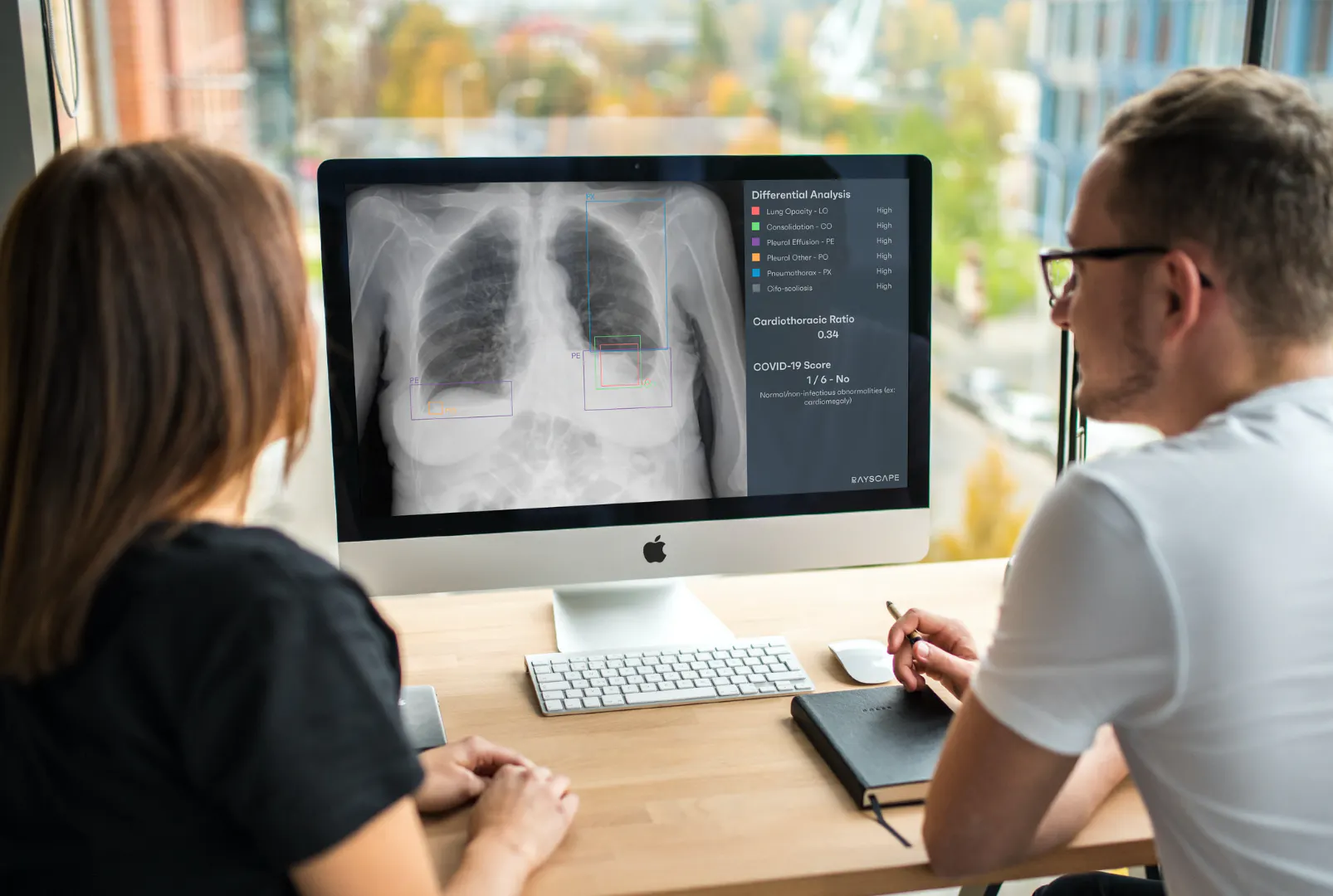
Given this context, it becomes evident that AI algorithms focusing on improving logistics and streamlining workflow, including aspects such as study ordering and acquisition, radiologist scheduling, report generation, patient notification, and peer review, prove their value by enhancing diagnostic accuracy and expediting report turnaround times.
Moreover, these algorithms can have a positive impact on the well-being of radiologists themselves. A report published in 2016 by the American College of Radiology Commission of Human Resources highlighted radiologist burnout as the seventh-highest among all physicians and identified heavy workloads and severe time constraints as contributing factors. The report recommended the development of efficient workflows as a strategy to combat burnout, a strategy in which AI-based algorithms can undoubtedly play a significant role.
When considering the return on investment (ROI) of AI in healthcare, it is crucial to conduct comprehensive calculations that go beyond the cost of deploying individual algorithms. Evaluating the ROI should encompass not only the direct costs but also the internal organizational costs and the impact on workflows, clinicians, IT personnel, and clinical support staff. By accounting for these factors, healthcare institutions can gain a more accurate understanding of the true ROI of their AI investments and make informed decisions about the adoption and implementation of these technologies. Understanding the ROI is a critical step in fully harnessing the power of AI and unlocking its transformative potential in patient care.
References
- Do YA, Jang M, Yun BL et al. Diagnostic performance of artificial intelligence-based computer-aided diagnosis for breast microcalcification on mammography. Diagnostics (Basel). 2021;11(8):1409. doi: 10.3390/diagnostics11081409.
- Diamond M. Presentation: A proposed regulatory framework for modifications to artificial intelligence/machine learning. 2020. https://www.fda.gov/media/135713/download. Accessed March 7, 2022.
- Chen MM, Golding LP, Nicola GN. Who will pay for AI? Radiol Artif Intell. 2021;3(3):210030. doi: 10.1148/ryai.2021210030.
- "cpt-category3-codes-long-descriptors.pdf.” 2022. https://www.ama-assn.org/system/files/cpt-category3-codes-long-descriptors.pdf. Accessed March 1, 2022.
- Criteria for CPT® Category I and Category III Codes. American Medical Association. https://www.ama-assn.org/practice-management/cpt/criteria-cpt-category-i-and-category-iii-codes. Accessed February 17, 2022.
- Weeks BW, Weinstein JN. Caveats to consider when calculating healthcare value. Am J Med. 2015;128(8):802-803. doi: 10.1016/j.amjmed.2014.11.012
- Rimmer, A. Radiologist shortage leaves patient care at risk, warns royal college. doi:10.1136/bmj.j3855.
- Statista. The number of magnetic resonance imaging (MRI) scan examinations in the Netherlands from 2008 to 2019. https://www.statista.com/statistics/609151/magnetic-resonance-imaging-scan-examinations-in-the-netherlands/ (2022).
- OECD. Health at a Glance 2021: OECD Indicators - Diagnostic technologies. https://www.oecd-ilibrary.org/sites/ed023875-en/index.html?itemId=/content/component/ed023875-en (2021).
- Griffith, B., Kadom, N. & Straus, C. M. Radiology Education in the 21st Century: Threats and Opportunities. Journal of the American College of Radiology 16, 1482–1487 (2019).
- Sahni, Nikhil and Stein, George and Zemmel, Rodney and Cutler, David M., The Potential Impact of Artificial Intelligence on Healthcare Spending (January 2023). NBER Working Paper No. w30857, Available at SSRN: https://ssrn.com/abstract=4334926 or http://dx.doi.org/10.2139/ssrn.4334926
- Dan Lantsman C, Barash Y, Klang E, Guranda L, Konen E, Tau N. Trend in radiologist workload compared to the number of admissions in the emergency department. Eur J Radiol. 2022 Apr;149:110195. doi: 10.1016/j.ejrad.2022.110195. Epub 2022 Feb 3. PMID: 35149337.

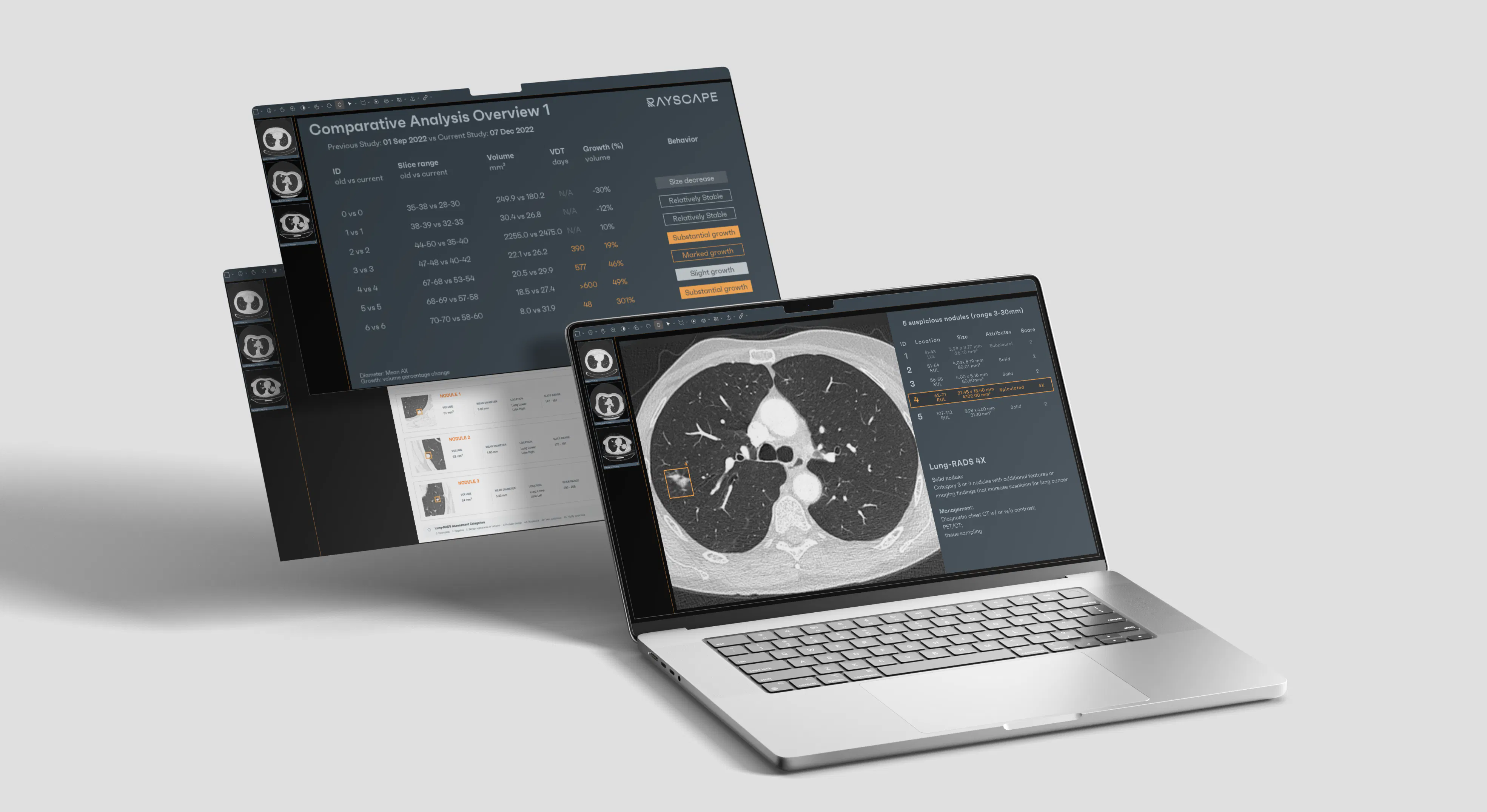

Discover how Rayscape works
integrate Rayscape AI into
your hospital's infrastructure
and improve both your
daily workflow and patients' experience.
